Monthly Insight
A space for thoughtful leadership in motion. Each month, you’ll find a new theme — with reflections, tools, and practice prompts to help you realign with your values, lead with clarity, and move forward with intention. Whether you’re in a season of change or simply seeking perspective, this is here to support your next aligned step.
April’s Theme — Living Your Values
This guided process walks you through clarifying your core values, narrowing them to what truly matters, and translating them into clear, observable behaviors.
You’ll also identify where you’re out of alignment and apply your values to a real decision—so this isn’t just reflection, it’s action.
March’s Theme: Support and Sponsorship-- Strength in the Roots.
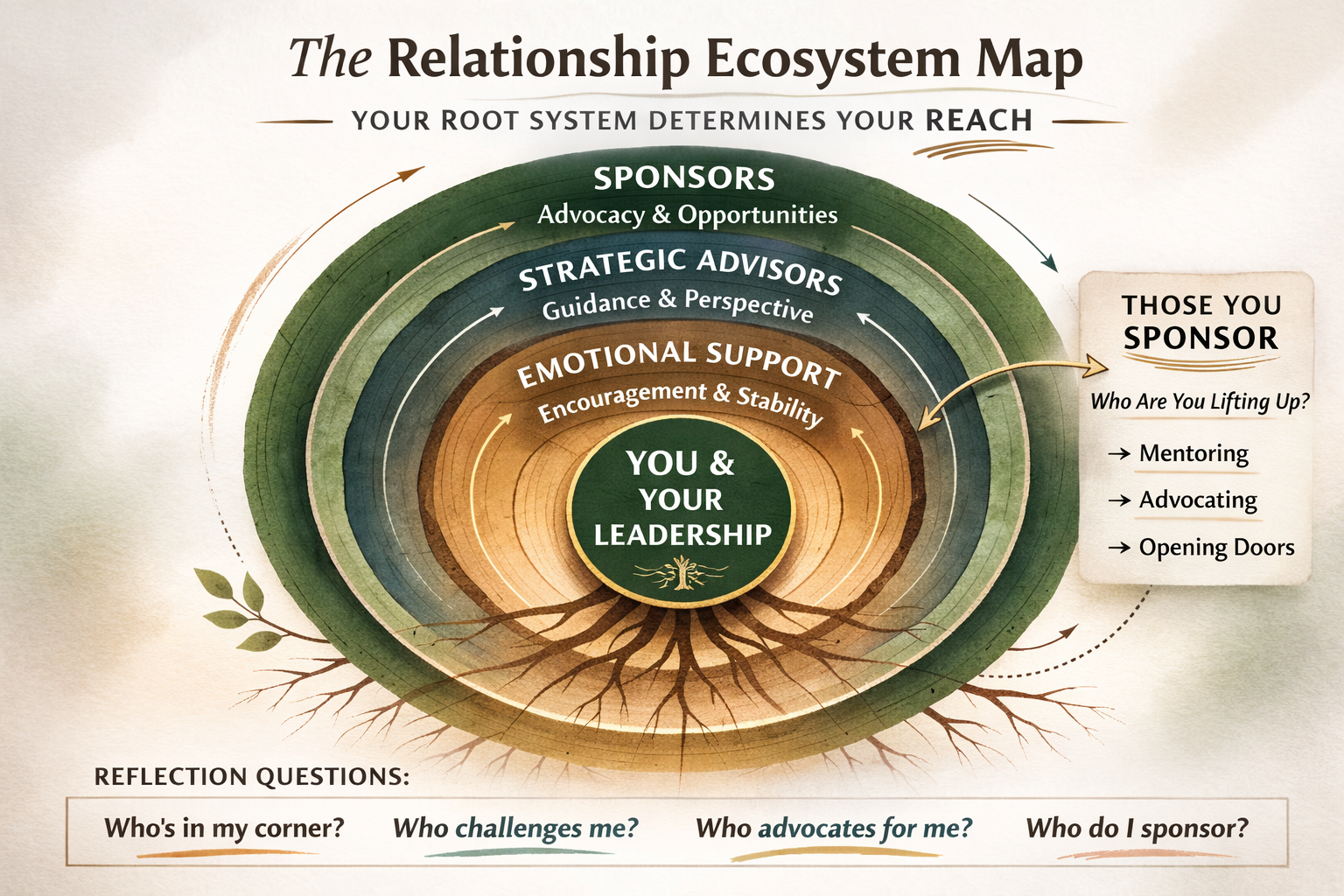
The Relationship Ecosystem Map is a practical tool to help you name the people who steady, challenge, advise, and advocate for you. It’s not about having more connections — it’s about strengthening the right ones.
This month’s blog explores a simple truth: no leader grows alone. I share reflections on how early sponsors shaped my confidence and why support and sponsorship are foundational to sustainable leadership. If you’ve ever wondered who’s in your corner — or who you’re lifting — this one’s for you.
February’s Theme: Designing Brave Systems
Meetings are one of the clearest places where psychological safety is either built — or quietly shut down. In this video, I explore why many leaders try to keep meetings efficient and controlled, and how that instinct — while understandable — can unintentionally signal that disagreement isn’t welcome. When people sense decisions are already made, they stop raising concerns, risks surface too late, and organizations lose valuable insight.
Brave work doesn’t depend on people being fearless — it depends on how leaders respond in real moments. This month’s resource is a practical Leader Response Playbook designed to help leaders build psychological safety through everyday interactions.
Rather than focusing on intentions, this tool offers simple response patterns leaders can use when risks are raised, mistakes occur, disagreement surfaces, or silence shows up. The goal isn’t perfect language — it’s sending consistent signals that make speaking up possible.
We often ask people at work to be courageous — to speak up, name risks, and challenge assumptions. But courage shouldn’t depend on personality or position. It’s shaped by how leaders design the system people are operating in.
In this month’s blog, I explore why psychological safety is a leadership responsibility — not a feel-good concept — and how everyday responses to disagreement, mistakes, and bad news quietly determine whether people speak up or stay silent. Drawing from my experience building a new program with people from very different backgrounds and perspectives, I share what it actually takes to create conditions where honest dialogue and brave work are possible.
January’s Theme: Wellness As Leadership Strategy

This practical January resource helps leaders build habits that actually stick by strengthening the foundation beneath their leadership. The guide includes three original tools: The AG Effect Energy Audit, What Drains Me / What Restores Me mapping, and Your Personal Regulation Menu. Designed to support awareness, regulation, and sustainability, these tools help leaders move out of depletion and into practices that build capacity, resilience, and grounded leadership over time.
January habits don’t fail because leaders lack discipline—they fail because they’re built on depleted systems. In this post, Angela Gladwell reframes habit formation through a leadership and well-being lens, showing why sustainable habits start with the body, energy awareness, and nervous system regulation—not willpower. Using a roots-up framework, she explores how grounded habits support clearer judgment, steadier presence, and leadership that lasts beyond January.
December’s Theme: Connection and Belonging

We’ve all seen them—values on the wall that no one really knows how to use.
This month, I’m exploring what it actually means to live your values—not just name them. In this blog, I dive into the gap between intention and alignment, why values often fall apart under pressure, and how getting clear on what truly matters can transform the way you make decisions and lead others.
This guided process walks you through clarifying your core values, narrowing them to what truly matters, and translating them into clear, observable behaviors.
You’ll also identify where you’re out of alignment and apply your values to a real decision—so this isn’t just reflection, it’s action.
The Relationship Ecosystem Map is a practical tool to help you name the people who steady, challenge, advise, and advocate for you. It’s not about having more connections — it’s about strengthening the right ones.
November’s Theme: Coping With Courage
Coping keeps us alive; courage helps us live.
This reflection guide helps you recognize when coping has turned into self-protection that no longer serves you—and offers mindful practices to move toward conscious, values-aligned courage.
We all cope — sometimes through control, perfection, or silence.
But there comes a point when coping stops serving courage.
This reflection on Coping with Courage invites you to notice where you’re pulled off center and how awareness and aligned action can bring you back.
October’s Theme: Regulating in Complexity
In today’s noisy, emotionally charged environment, leaders set the tone whether they realize it or not. Fear, urgency, and outrage spread quickly — but so do calm, curiosity, and steadiness. This post explores why emotional regulation is no longer optional, but a core leadership skill. Drawing on real-world experience, it highlights how calm is not passive but powerful, and offers simple practices to help leaders stay centered under pressure. Because in the end, the noise won’t stop — but how you move through it determines your impact.
This month’s Reflection Guide invites leaders to practice Regulating in Complexity — staying centered under pressure without shutting down or avoiding hard truths. Each week offers a focus, reflection questions, an affirmation, and a simple daily practice. Together, these prompts help you notice your emotional patterns, bring more steadiness into charged environments, and strengthen the mindsets that make leadership sustainable.
The October Reading List expands on this month’s theme, Regulating in Complexity. Each week pairs the Reflection Guide with selected books and articles that explore emotional agility, the power of structure, integrative thinking, and sustainable leadership mindsets. These readings provide deeper insight and practical wisdom to help leaders navigate complexity with calm and clarity.
September’s Theme: Meaning in Motion
The Meaning in Motion Mini Guide
This guide is a reflective resource to help you ground in purpose during times of change. Inside, you’ll find prompts to check in with your identity, explore cultural legacy, and map your aspirations—what you want to learn, share, and leave behind. Use it as a compass to reconnect with meaning and carry your purpose forward
The Second Curve Compass Quiz
A quick self-check inspired by Strength to Strength. In just a few minutes, you’ll discover whether you’re still fueled by achievement, leaning into wisdom and legacy, or standing at the bridge between the two—and get practical tips to take your next purposeful step.
Meaning in Motion: Finding Purpose When Everything Shifts
When roles, titles, or certainty fall away, it can feel like losing part of yourself. This post explores how purpose reemerges through reflection and small, intentional steps—reminding us that meaning isn’t static, it evolves with us.
August’s Theme: Safe Enough to Grow
Compassionate Boundaries: Leading Without Burning Out
Boundaries aren’t barriers—they’re the foundation for sustainable leadership. In this article, I share my own journey of letting go of guilt, setting limits, and modeling healthy practices for my team. Discover why boundaries build trust, reduce burnout, and create the conditions for real compassion at work.
This short, powerful guide offers reflection prompts, boundary check-ins, and grounding practices to help you reconnect with what makes growth possible—even in uncertain systems. Perfect for quiet moments, coaching prep, or monthly resets.
Use it to pause, breathe, and lead from a place of presence—not pressure.
In a world of complexity and pressure, psychological safety isn’t a perk—it’s a prerequisite for real leadership and growth. This post unpacks the high cost of fear, what true safety looks like, and how leaders can cultivate environments where people feel safe enough to speak up, challenge norms, and thrive. Growth doesn’t happen in pressure—it happens in presence.
August 2025 Newsletter
Safe Enough to Grow
In my very first newsletter, I share why psychological safety is personal, what it means to grow through uncertainty, and how compassion and boundaries fuel real leadership. Includes coaching tools, a reflection guide, and an invite to this month’s group session.
July’s Theme: Hope Reclaimed
In “Hope Has a Plan,” Angela Gladwell reframes hope as a leadership strategy—not a feeling, but a learned, intentional practice. Drawing on insights from Brené Brown and her own career transition, she explores how clarity emerges through values, vision, and small, courageous steps. This post offers both reflection and a practical tool for moving forward when the path feels uncertain.
In this month’s video, we reflect on hope as more than optimism — it’s clarity, agency, and the courage to take one small step forward.
How do you hold on to possibility when everything feels uncertain? In this month’s theme, we reflect on hope as more than optimism — it’s clarity, agency, and the courage to take one small step forward.
We’ve all seen them—values on the wall that no one really knows how to use.
This month, I’m exploring what it actually means to live your values—not just name them. In this blog, I dive into the gap between intention and alignment, why values often fall apart under pressure, and how getting clear on what truly matters can transform the way you make decisions and lead others.