
We often talk about courage at work — speaking up, naming risks, challenging assumptions, learning from failure. But too often, we place the burden of courage on individuals without asking a more important question:
Have we actually built a system where courage is possible?
Psychological safety isn’t about comfort. It’s not about lowering standards or avoiding hard conversations. It’s about designing environments where people can tell the truth, contribute fully, and take responsible risks without fear of humiliation or retaliation.
At The AG Effect, psychological safety lives in the roots of my leadership model — alongside well-being and support — because without it, authenticity and growth can’t take hold.
You can ask people to be brave.
Or you can design systems that support brave work.
Only one of those actually works.
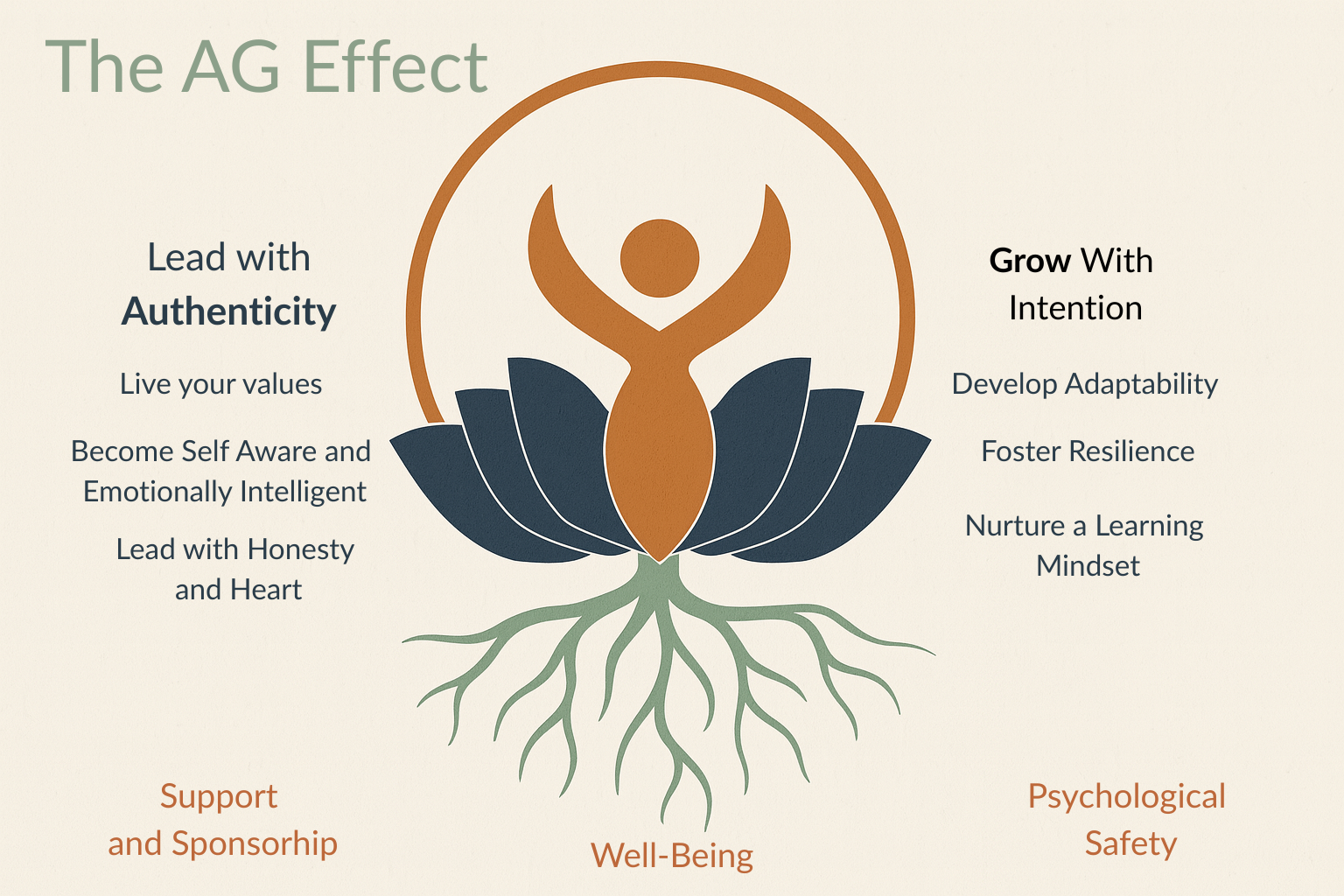
Where Psychological Safety Lives in My Leadership Model
My leadership model rests on two visible pillars — Authenticity and Growth — but those pillars are only stable when the roots are strong.
Psychological safety is one of those roots.
Authenticity requires safety to tell the truth, admit uncertainty, and show up honestly.
Growth requires safety to experiment, make mistakes, and learn without shame.
Well-being depends on not operating in constant self-protection.
Support and sponsorship only function when people trust that speaking up won’t cost them.
Without psychological safety, leaders may say they value honesty and learning — but people will quietly choose silence instead.
And silence is never neutral.
A Leadership Lesson I Learned the Hard Way
One of the most meaningful leadership challenges of my career came when I was asked to stand up a brand-new program under intense pressure — tight timelines, public scrutiny, legal complexity, and a team made up of people with vastly different professional backgrounds, lived experiences, and ways of seeing the world.
The talent was extraordinary.
The commitment was real.
But safety was uneven.
People didn’t yet understand where others were coming from. Some carried institutional scars. Others were new to the work. Many were unsure which risks were acceptable to name — and which truths might backfire.
So before we could do brave work, we had to design the conditions for it.
That meant:
Slowing down to help people understand each other’s experiences and perspectives
Naming the reality that trust had not yet been built — and that this was normal
Modeling vulnerability as a leader, not as oversharing, but as truth-telling
Giving explicit permission to say the hard things, question assumptions, and name risks early
Responding to disagreement and bad news with curiosity instead of defensiveness
Over time, something shifted.
People began to speak up sooner.
Risks were surfaced before they became failures.
Disagreements became productive instead of personal.
Not because the work got easier — but because the system got safer.
That’s what designing a brave system looks like.
What Brave Systems Have in Common
Brave systems don’t rely on heroic individuals. They rely on predictable leadership behavior.
In psychologically safe systems:
People know how leaders will respond to bad news
Mistakes are examined, not weaponized
Disagreement is treated as data, not disloyalty
Silence is seen as a signal, not compliance
And when safety breaks — as it inevitably will — leaders repair it openly, without minimizing harm or rushing to “move on.”
The Leadership Question for This Month
As we move through February, I invite you to reflect on this question:
What have you designed — intentionally or unintentionally — that shapes whether people feel safe to speak, learn, and contribute?
Because courage isn’t a personality trait.
It’s an outcome of design.
And brave systems don’t happen by accident.