
Making Resilience Possible
Last month, I wrote about a challenge I see affecting leaders across every sector: change is outpacing recovery. Many of us are no longer leading through isolated periods of disruption — we're leading in an environment where uncertainty has become a constant companion.
So if this is the new reality, I have been pondering what makes resilience possible?
For much of my career, I thought resilience was primarily something individuals developed. And I still believe that personal resilience matters deeply. Each of us has to discover what keeps us grounded when circumstances around us are uncertain.
What I've learned, though, is that everyone's path to resilience looks a little different.
My own resilience has depended on having opportunities to pause and recover before moving into the next challenge. It means paying attention to and managing my energy instead of assuming I can always push a little harder. It also means returning to my purpose and values when uncertainty threatens to pull me in too many directions.
Someone else may find resilience through physical activity, faith, time in nature, close relationships, or creative expression. There is no single formula because there is no single human experience.
Over time, however, I began to notice that no matter how intentional I was about building my own resilience, there were certain conditions in my environment that made it either easier or much harder to sustain.
When I felt psychologically safe to raise concerns or admit I didn't have all the answers, I had more capacity to navigate uncertainty. When there was space to reflect, learn, and adjust instead of simply reacting, I became a better leader. Those conditions didn't remove the pressure, but they changed how I experienced it.
That's when my thinking shifted.
Resilience isn't just something we build within ourselves — it's also something leaders can help make possible.
As leaders, we may not be able to eliminate uncertainty. But we have tremendous influence over the conditions in which people experience it. That begins by recognizing that different people may need different things to do their best work—and by engaging our teams with genuine curiosity about what helps them remain grounded, grow, and recover.
In today's world, where change often arrives faster than recovery, that may be one of the most important leadership conversations we can have.
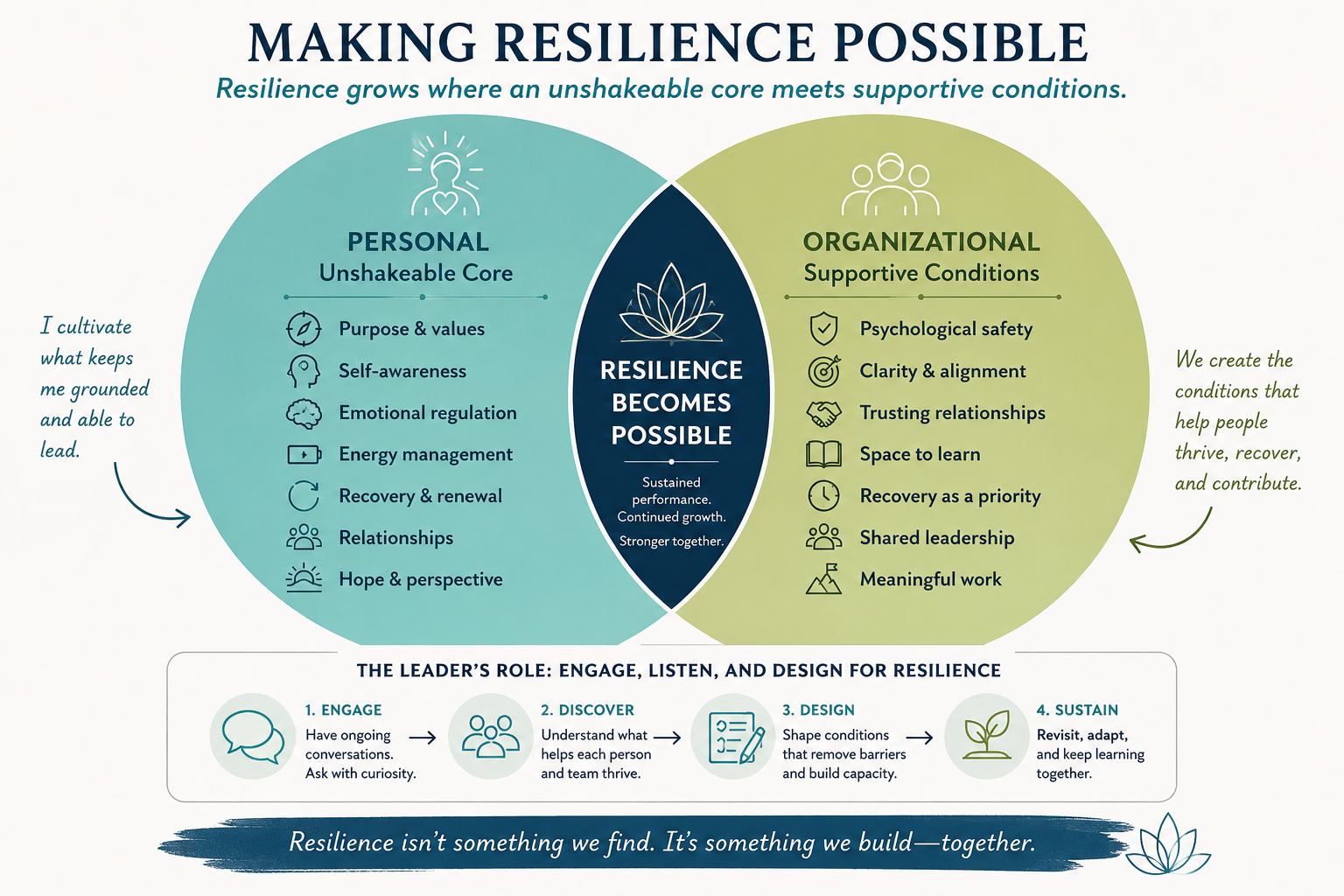
The graphic above illustrates how I now think about resilience.
For years, I saw resilience as something we developed within ourselves. Today, I see it as something that emerges at the intersection of two responsibilities: the responsibility we each have to strengthen our own foundation and the responsibility leaders have to create environments where people can thrive.
Neither is enough on its own.
Even the most grounded, self-aware leader will struggle to sustain resilience in an environment characterized by chronic ambiguity, fear of speaking up, unrealistic expectations, or relentless pressure with no opportunity to recover. At the same time, even the healthiest organizational culture cannot substitute for the personal work each of us must do to understand ourselves, manage our energy, and remain connected to our purpose.
Resilience grows where those two realities meet.
That intersection is where leadership becomes both deeply personal and deeply relational.
It requires us to ask two different sets of questions.
The first is inward:
What helps me remain grounded when uncertainty is high?
The second is outward:
What helps the people around me remain grounded?
Those answers may not be the same.
As a coach, one of the things I've learned is that resilience is remarkably personal. Some people regain energy through quiet reflection, while others need conversation. Some need greater autonomy; others need more connection. Some find perspective in nature, faith, or exercise. Others recover through creativity, learning, or time with family. There is no universal formula.
That means leaders cannot assume that what builds resilience for them will build resilience for everyone else.
Instead, we have to become curious.
We have to engage our teams in conversations about what helps them do their best work, what drains their capacity, and what allows them to recover and grow. We have to pay attention not only to performance, but to the conditions that shape performance.
When we do, resilience stops being something we expect from people and becomes something we intentionally cultivate together.
In a world where change continues to outpace recovery, that shift may be one of the most important responsibilities of leadership.
We cannot remove every challenge our teams will face.
But we can strengthen our own foundation, help others strengthen theirs, and create environments where resilience is far more likely to flourish.
Continuing the Conversation
I work with organizations that are navigating complexity, uncertainty, and continuous change.
Together, we help leadership teams create greater clarity, strengthen organizational health, and build the conditions that allow people to continue adapting—even when recovery remains incomplete.
If that sounds like your organization, I'd love to explore how I can help.