
Beyond Adaptability: When Change Outpaces Our Ability to Recover
Most of my career was in emergency management.
We often described our work as a cycle. Communities invest in mitigation and preparedness before disasters occur. When an event happens, attention shifts to response and then recovery. The lessons learned are used to strengthen mitigation and preparedness efforts before the next event.
The model is useful because it reminds us that all parts of the cycle are equally important, and that resilience is built before a crisis, not after.
But reality is often messier than the diagram.
Recovery efforts frequently begin before response activities are fully complete. Mitigation projects are underway while communities continue rebuilding. New disasters sometimes occur before recovery from previous events has ended.
The work rarely unfolds in neat, sequential phases.
Leadership often works the same way.
We like to think of challenges as discrete events. We address one problem, recover, stabilize, and then move on to the next. Increasingly, though, that isn't how leadership feels.
A few weeks ago, I was talking with the leader of a nonprofit organization.
What began as a conversation about one challenge quickly became a conversation about many.
First, she described policy changes that were bringing more people through their doors seeking services. The needs in the community were growing, and her team was working hard to keep up.
Then she talked about funding. Traditional funding sources had shifted, leaving the organization searching for ways to fill emerging gaps.
Transportation costs were rising, creating additional strain on a budget that depended heavily on getting people where they needed to go across a largely rural service area.
Staff turnover remained a challenge. Recruiting and retaining talented employees was difficult. Volunteers came and went. Board members rotated off. Institutional knowledge walked out the door and had to be rebuilt.
As she talked, I noticed that none of these challenges were surprising on their own.
Many leaders could point to at least one of them and say, "We're dealing with that too."
The challenge wasn't any single issue -- it was the accumulation.
Before one problem was fully addressed, another emerged. Before a funding gap was closed, demand increased. Before a new employee was fully onboarded, someone else left. Before a process was stabilized, external conditions shifted again.
What started years ago for this leader as a passion project had evolved into something far more complex. The mission remained the same, but the environment around it had changed dramatically.
Listening to her, I was reminded of a pattern I've been seeing across sectors.
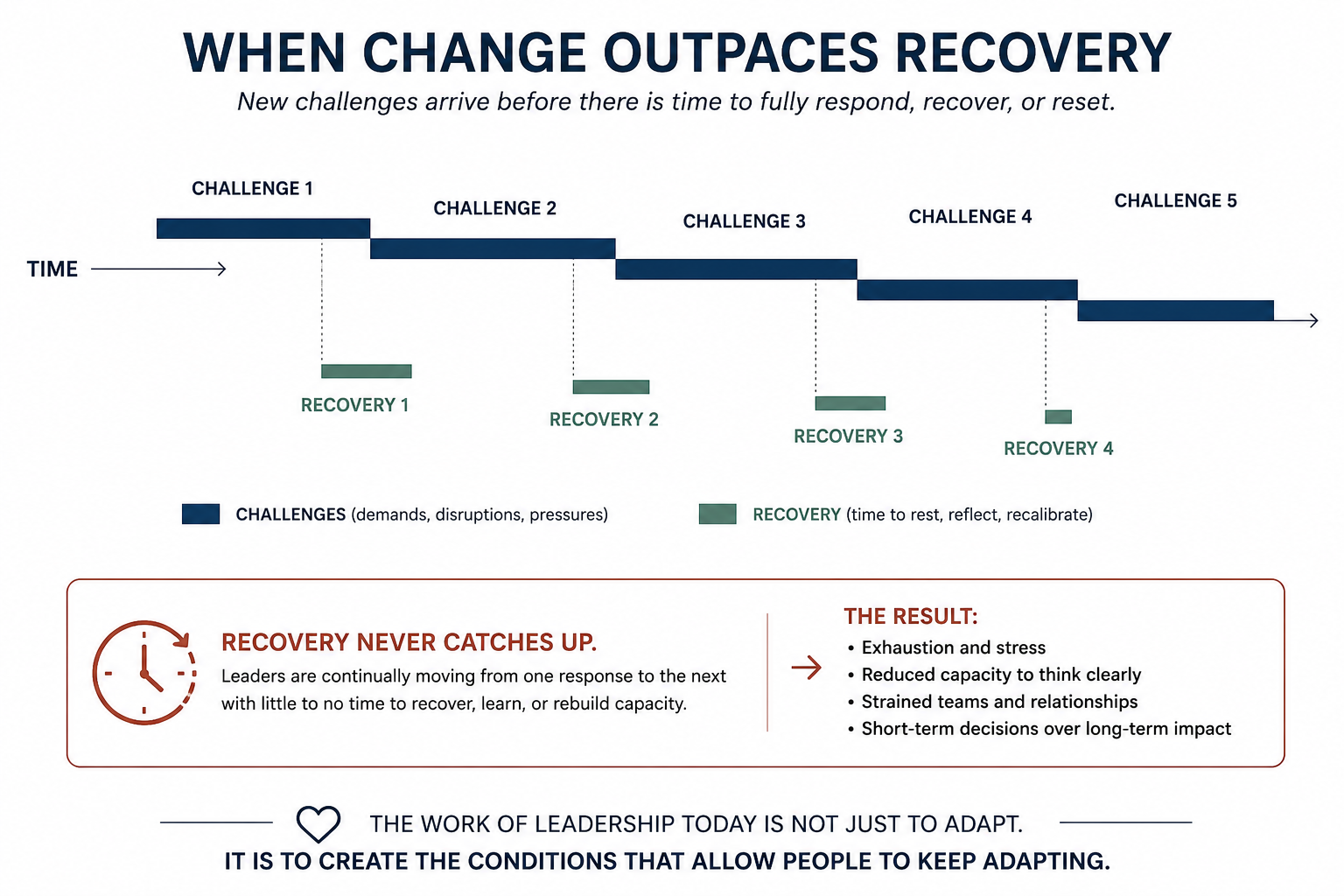
As new challenges arrive before recovery from previous ones is complete, leaders face an expanding gap between the pace of change and the opportunity to recover.
Many leaders are no longer navigating isolated periods of change. They are leading through a continuous stream of overlapping demands, disruptions, and uncertainties.
The traditional leadership narrative often assumes there will be time to recover between challenges. Adapt, stabilize, move forward, and then respond to the next issue.
Increasingly, that isn't how leadership feels. The next challenge often arrives before recovery from the last one is complete.
As I began exploring this pattern, I found researchers in very different fields describing remarkably similar dynamics. Researchers studying community resilience have increasingly focused on cumulative stressors -- the way multiple challenges interact and compound over time. Rather than experiencing one event, recovering, and moving on, communities often navigate overlapping events and pressures that affect the health and well-being of community members, and both the individuals’ and communities’ ability to adapt.
This sounded so very familiar.
Not because I was thinking about communities, but because I was thinking about organizations.
Many organizations today are experiencing their own version of cumulative stressors. Technology is evolving faster than many organizations can effectively integrate it. Workforce expectations and needs continue to shift. Funding models are changing. Community needs are changing. The broader social, economic, and political environment continues to evolve, sometimes abruptly.
Again, none of these challenges are necessarily new.
What feels different is the pace.
The leaders I talk with are not describing one major disruption followed by a period of recovery and stabilization. They are describing a continuous cycle of adjustment. By the time one issue begins to settle, another demands attention. By the time a team adapts to a new reality, that reality shifts again.
This may help explain why so many capable leaders feel exhausted despite doing all the "right" things.
The challenge facing many leaders today is not simply change itself. It is the growing gap between the pace of change and the ability of people and organizations to recover from it.
That realization has changed the questions I ask leaders.
For much of my career, the focus was often on adaptation. How do we solve this problem? How do we respond to this change? How do we navigate this challenge?
Those questions are still important.
But increasingly, I find myself asking a different question first:
What do our people need in order to continue adapting at a constant pace?
As I reflect on the leaders and organizations that navigate uncertainty most effectively, I notice something interesting. They spend less time trying to eliminate uncertainty and more time creating the conditions that help people work effectively within it.
They create clarity of purpose. They help people understand why the organization exists and who it serves.
They focus attention. In a world of distraction where it is easy to focus on everything at once, they help teams with discernment – understanding what is most important right now. Not for the next year. Not five years. Right now.
They shape healthy working environments. Trust, communication, clarity, shared expectations, healthy conflict, and accountability are not secondary concerns to be addressed once things settle down. They are the foundation that allows organizations to continue adapting when things do not settle down.
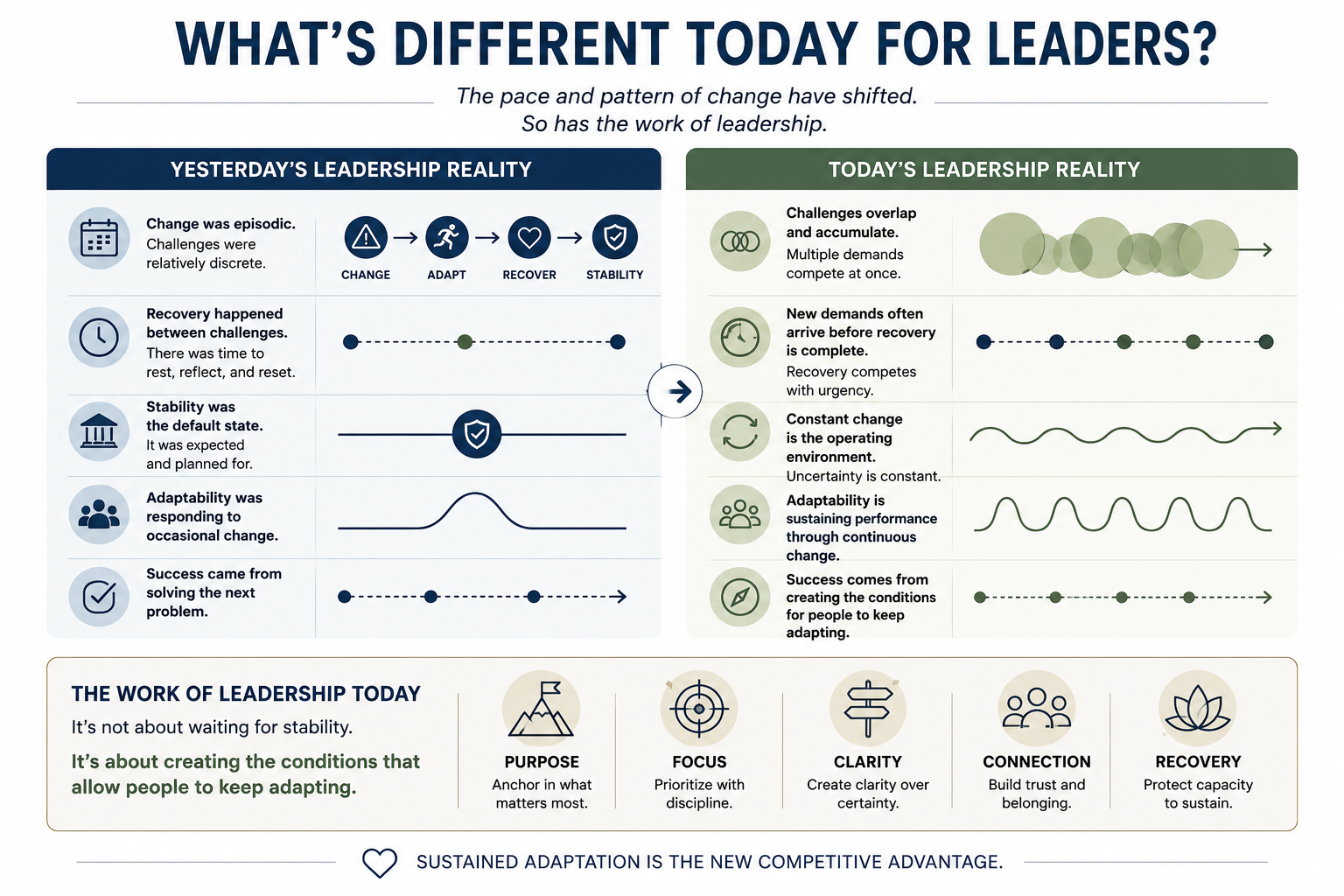
As change becomes continuous, the work of leadership shifts from managing change to sustaining adaptation.
Many of these ideas are not new. Patrick Lencioni described them years ago in The Advantage as essential elements of organizational health.
What may be different today is the role they play.
In a world where change often outpaces recovery, these practices are no longer simply ways to improve performance. They are ways to sustain it.
And nowhere is that more evident than in how leaders think about recovery.
When demands increase, the instinct is often to ask people to push harder. Sometimes that is necessary. But the most effective leaders understand that recovery is not the reward for performance -- recovery is one of the conditions that makes sustained performance possible.
If a team is working intensely toward a critical deadline, they build opportunities for people to recharge afterward. If one group has been carrying the load for an extended period, they look for ways to redistribute responsibility. They create flexibility where they can. They recognize that people are navigating complex realities both inside and outside of work.
They understand that managing energy levels is critical for sustained performance, and exhaustion is not a sustainable strategy.
I was recently talking with leaders in an organization that had spent years navigating a major reorganization. Throughout the process, many people believed things would settle down once the reorganization was finalized. Once decisions were made, there would finally be certainty, they thought.
Then the reorganization was completed -- and almost immediately, circumstances changed again. The certainty people had been waiting for never arrived.
What helped people move forward wasn't certainty -- it was clarity. What do we need to accomplish this week? How will we treat one another as we work through this? How will decisions get made? What does success look like?
Leaders cannot always provide certainty, but they can provide clarity. When people cannot predict the future, clarity becomes an anchor.
Adaptability remains essential, but adaptation alone is not enough.
The leaders I admire most are not adapting once and moving on. They are intentionally creating the conditions that allow their people, organizations, and communities to adapt again and again.
Unfortunately, many leaders don’t invest in creating those conditions because they feel they are too busy, or they fail to see how dependent success over the long term is on the ability for team members to see through fog, manage their energy, and bring their best selves to advance the most important elements of the work.
In a world where change often outpaces recovery, that may be one of the most important leadership responsibilities we have.
Further Reading
The ideas in this article were influenced by research and reports exploring community resilience, organizational adaptation, and nonprofit leadership, including work on cumulative stressors and resilience from the National Academies Gulf Research Program, the Center for Effective Philanthropy's State of Nonprofits 2025, and recent discussions about the growing gap between the pace of change and organizational readiness
Continuing the Conversation
I work with organizations that are navigating complexity, uncertainty, and continuous change.
Together, we help leadership teams create greater clarity, strengthen organizational health, and build the conditions that allow people to continue adapting—even when recovery remains incomplete.
If that sounds like your organization, I'd love to explore how I can help.
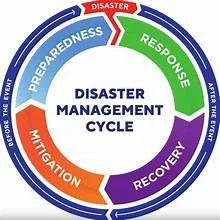
Traditional Assumptions
Each of these happen in sequence, resulting in stability.